 |
|||
Advertising & Small Business
|
|||
 |
|||
Reflections on Christianity |
|||
 |
|||
Road Rave |
|||
 |
|||
Random Acts of Ryan |
|||
 |
|||
Travel & Adventure Tales |
|||
 |
|||
About the Author |
|||
|
|||
Tomorrow Never Dies
02.03.11
There's a magnet on my parents' fridge that says, "When you really need to know, ask a librarian." It makes me pause every time I see it now.
It was just the other week that I wondered to myself how much longer public libraries will be a regular occurrence in our cityscapes. With the Internet, I can often retrieve an answer in the time it takes a librarian to walk to the reference section. I can buy used copies of some of the books that interest me online for only abut three or four times the cost of gas to drive to one of the public libraries near my house—worth it for my time.
A librarian, as knowledgeable and helpful as they prove to be, is looking more and more like a travel agent to me—someone to help the elderly and offline do things the rest of us can do for ourselves. That's a broad brush, I know. But, seriously, when was the last time you grabbed a nonfiction book from a public library?
I reflected back to my high school years as a library page. It makes me chuckle now, since I've never been much of a reader; and I don't have much of an inside voice. The library for me at that time was a social place in our colonial town of Centreville, MD, especially for families with small kids. It was where I practiced public speaking with the home school cooperative that met in the conference room; it was where I first saw political liberalism as a majority view in an environment and learned to have a reason for what I believed and an open mind for what I didn't.
Fast forward to my week in Vancouver. I wanted a quiet place to write. My hostel situation negated that; the downtown coffee shops were too loud and active for concentration; the outdoors were stunningly beautiful but chilled by a wet December.
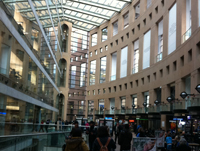
So, I took my iPad and Bluetooth keyboard to the Vancouver Public Library's internationally-acclaimed central branch. It held a food court, which in turn held a crowd of people waiting like black Friday shoppers for the glass doors to open. Six light-filled floors offered more books that I'd ever seen in one place, desks (each with power outlets) lining a circular glass wall to the outside world, free WiFi, self-checkout kiosks, security detail, captivating cultural displays—even a professional writer in residence. Oh, and a store that sold literature-related and library-themed gifts.
The architectural masterpiece was filled with Asian students doing math beyond my pay grade and grizzled urban bachelors reading and scratching notes—and more librarians than I've ever seen in one place at one time. I read one poster that said they could be hired by the hour to research projects on your behalf—I assume for commercial ventures.
This library proved very much alive and nowhere near extinction. British Columbia's salty new Harmonized Sales Tax may have something to do with that, but the facility had adapted to the changing culture around it to stay relevant—at least for the foreseeable future.
One of my auction industry friends, Matt, posted on Facebook the other day about how auction marketing is changing and scary and forcing constant adaptation. I'm very thankful to be on my end of the transaction during these tumultuous times in an uncertain economy, and I tip my hat to the auction entrepreneurs who risk so much as part of their lifestyle.
So, how are you adapting your business model to stay relevant to culture? What are the elements of your service product that you can emphasize to appeal to where culture is now and will be in a year, five years, ten? Where will you need to acquire more education and/or hire a specialist to develop emerging technologies and markets?
The sky's not falling, but the world is still spinning underneath it—seemingly faster every year. As the auction practitioner ages and more conglomerates grab lucrative accounts, what are you doing to compete as an entrepreneur? Part of that is marketing, and I'm on that unchartered ride with you. The rest will fall to the perceptive and courageous to conquer. May that be you!
Lots of conversations, even debates, have been held to discuss how the church should interact with an evolving Western culture. Some try to pep their music. Others loosen the dress code. Still others insert big screens with song lyrics and sermon illustration videos. On the flip side, people from my religious heritage thumb their nose at change and wrap themselves in the warm blankets of exclusivity and traditionalism; thus, the secular has to come to the sacred on rigid terms or stay where they are.
Frankly, the Bible doesn't indicate whether your church's walls should vibrate with amps and drums or from regal pipe organs or whether your church atrium should include a coffee shop or suited ushers. Contemporary is a moving target, and you can chase "cool" like a high schooler until you realize that contemporary isn't the point. Relevance is. However you package a church environment, what changes the world is supernatural love—compassion expressed with authenticity, empathy, and an overwhelming hope.
What hasn't changed in culture is the need for healing and the source of that healing. Our job, as kingdom workers, is to express the welcome and reality of God's prodigal Gospel in whatever way it will be most easily attained by those whose lives we touch. That will often come at the cost of our own comfort, sensibilities, and habits. That shouldn't surprise us. Jesus gave up the amenities and stability of heaven to walk amongst an upheaved earth.
As local assemblies, we have to regularly remind ourselves that the how and what we do must be sifted by the whom for which we are doing it—both vertically and horizontally. Otherwise, as my buddy Jack says, "We become keepers of the aquarium, instead of fishers of men."
Your Comments
Email them to Ryan
© 2006, 2007, 2008, 2009, 2010 biplane productions, inc. & ryan george